There is something oddly satisfying about knowing the exact day when a future date will arrive. We say, “three years from now,” or “ten years down the road,” as if time were a long straight road with little signboards on it. But calendars are less tidy than our imagination, and sometimes you need the precise answer, not a rough guess.
The Years From Now Calculator is made for exactly that small but useful job. It helps you discover the exact date that falls a certain number of years from a starting date, along with the corresponding day of the week, total weeks, and total days. It’s the kind of calculator you may open for one quick question and then realise it saves you from doing a surprising amount of calendar counting yourself.
For example, suppose you need to know when exactly 3 years from now will be. Enter 3 into the calculator, and the future date and related calculations can be shown almost instantaneously. Pretty handy, especially when leap years, varying month lengths, and those slightly annoying calendar details start getting involved.
This guide explains how the calculator works, what its inputs and outputs mean, and how to understand a result without staring at the calendar like it has personally offended you.
| Category | Keywords / Entities |
|---|---|
| Primary Keyword | Years From Now Calculator |
| Secondary Keywords | Years From Today Calculator, years from today, years from now |
| Core Entities | Calculator, Date, Current Date, Future Date, Calendar |
| Time Entities | Years, Months, Weeks, Days |
| Calculation Terms | Date Calculation, Date Arithmetic, Future Date Calculation |
| Output Terms | Exact Date, Day of the Week, Total Weeks, Total Days |
| Intent Keywords | Calculate years from today, date years from now, future date calculator |
| Related Terms | Online Calculator, Date and Time, Calendar Date, Time Duration |
What Is a Years From Now Calculator?
A Years From Now Calculator is a simple date calculator that adds a chosen number of years to a starting date. In the most straightforward use, the starting point is today’s date, and the calculator moves forward by the number of years you enter.
So, if the starting date is March 12, 2026, entering 1 means you want to find the date one year after March 12, 2026. The answer is March 12, 2027. Enter 5, and the result becomes March 12, 2031.
The useful part is that the tool doesn’t merely give you a date. It can also show the day of the week, total weeks, and total days, which makes the result easier to understand. A person could calculate these manually, sure, but calendars have a sneaky habit of making simple things less simple than they look.
The calculator is associated with TimeDuration Service, and its purpose is very focused: give a clear future-date result without requiring the user to perform calendar arithmetic themselves.
Why Calculate Years From Now Instead of Guessing?
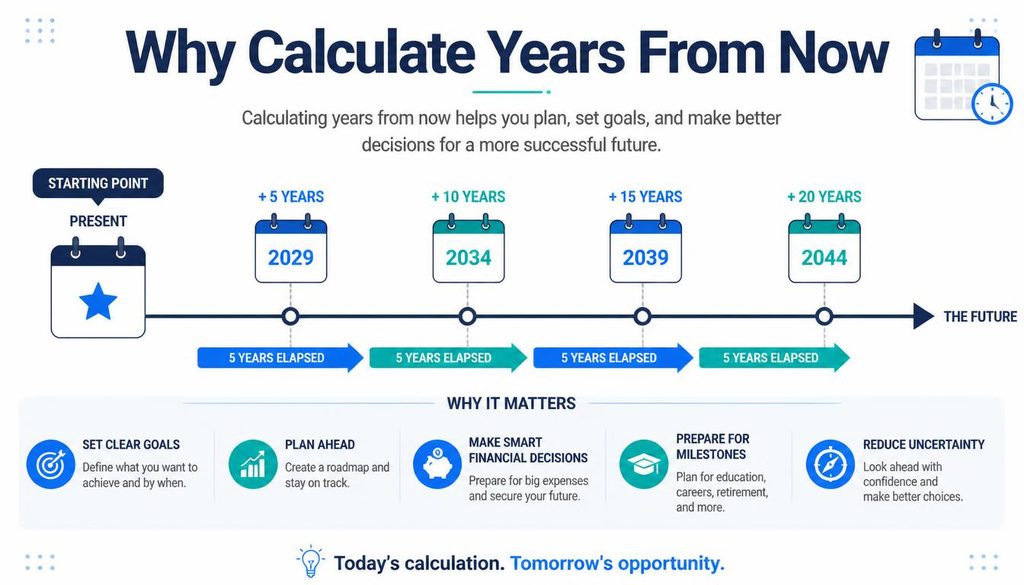
People often think adding years is as easy as adding the same number to the year. Most of the time, for the date itself, that is true. But understanding the exact duration in days or weeks is where things become more interesting.
A year does not always contain the same number of days. A regular year contains 365 days, while a leap year contains 366. That extra day can affect calculations involving total days and total weeks, even though the month and day may look unchanged.
For instance, March 12, 2026, falls on a Thursday. Three calendar years later, March 12, 2029, falls on a Monday. The date looks almost identical, but the weekday has wandered several places across the calendar.
This is why an automated calculator can be useful. It quietly handles the calendar math while you get on with whatever made you ask the question in the first place. Maybe you’re planning an event, checking a long-term milestone, or just wondering where a particular date lands. All perfectly reasonable uses, really.
Years From Now Calculator Example
Consider the following example based on a starting date of March 12, 2026:
📅 Years From Now: 0 years
📅 Date: March 12, 2026
🌞 Day: Thursday
📅 Total Weeks: 11 weeks
📅 Total Days: 70 days
The “0 years from now” part simply means no additional years have been added to the starting date. Therefore, the resulting date remains March 12, 2026.
The example also illustrates that a calculator may display additional duration information alongside the date. In this particular supplied example, 70 days corresponds to 10 weeks exactly, so if a display says 11 weeks, that should be treated as a display/configuration detail rather than the mathematical equivalent of 70 days.
Little discrepancies like this are worth noticing instead of blindly copying them to calculate a future date, the most important output is the resulting calendar date. The weekday is the next useful detail, while total weeks and, becuase date tools should ultimately be understood by what their fields actually represent.
If the goal is specifically to calculate a future date, the most important output is the resulting calendar date. The weekday is the next useful detail, while total weeks and total days provide additional duration context.
How to Use the Years From Now Calculator
Using the calculator is intentionally straightforward. There is no complicated calendar interface to wrestle with, and you don’t need to manually count months on your fingers, which is probably for the best.
Step 1: Find the Years From Now Input
On the calculator, locate the input field marked Years From Now.
This field tells the calculator how many years you want to add to the starting date. If you want to find the date seven years after the selected starting point, enter 7.
The input is essentially your question written as a number: “How many years should I move forward?” The calculator handles the rest.
Step 2: Enter the Number of Years
Type the desired number into the input field.
For example, entering 7 asks the calculator to determine the date seven years from the starting date. There is no need to write “seven years” in a sentence; the number itself is what the calculator needs.
Once the value is entered, the results can be generated automatically. That’s the nice bit, because you don’t have to calculate weekdays or count the days between dates yourself.
Step 3: Read the Generated Results
After the number has been entered, the calculator displays the resulting date and other calendar information.
The output may include the exact date, day of the week, total weeks, and total days. In other words, one small input produces several useful pieces of information together.
For a quick calculation, this means you can look at the result and immediately understand both when the date occurs and how far away it is in calendar terms.
Years From Now Calculator Inputs and Outputs
The calculator has a very simple structure, which is part of its appeal. You enter a number and receive several pieces of information about the corresponding future date.
Years From Now
The Years From Now input represents the number of future years you want to add to the starting date.
If you enter 3, the calculation is based on adding three calendar years. If the starting date is March 12, 2026, the resulting calendar date is March 12, 2029.
This is different from saying “add exactly 1, asking, “What date will it be 15 years from now?”, this field gives the direct answer without095 days,” because calendar years can contain different numbers of days. The calculator is working with the calendar concept of years rather than merely treating every year as an identical 365-day block.
Date
The Date output gives the resulting calendar date after the specified number of years has been added.
This is usually the main reason someone uses the tool. If you’re asking, “What date will it be 15 years from now?”, this field gives the direct answer without requiring a separate calendar calculation.
Day
The Day output identifies the weekday on which the calculated date occurs.
This can be surprisingly useful. Knowing that a particular future date falls on a Tuesday or Saturday can make planning easier, especially for anniversaries, recurring weeks can vary.
This is one reason it’s useful to view the number as an additional duration measurement rather than assuming every year equals when you need a duration for planning or comparison.
A future date can feel vague when described as “five years away,” while a total-day figure gives the period a much more concrete shape events, deadlines, or long-range personal milestones.
Total Weeks
The Total Weeks output expresses the elapsed period in weeks according to the calculator’s calculation.
Because years do not always contain a fixed number of days, the exact relationship between years and weeks can vary. This is one reason it’s useful to view the number as an additional duration measurement rather than assuming every year equals precisely 52 weeks.
Total Days
The Total Days output shows the elapsed number of days represented by the calculation.
This is particularly useful when you need a duration for planning or comparison. A future date can feel vague when described as “five years away,” while a total-day figure gives the period a much more concrete shape.
Years From Today: A 1-to-50 Year Reference Table
The following table uses March 12, 2026 as the starting date and shows the corresponding date and weekday for 1 through 50 years later. The table is a reference based on the date supplied for this example, rather than a statement of the current date.
| Years From Today | Date and Day |
|---|---|
| 1 year | Friday, March 12, 2027 |
| 2 years | Sunday, March 12, 2028 |
| 3 years | Monday, March 12, 2029 |
| 4 years | Tuesday, March 12, 2030 |
| 5 years | Wednesday, March 12, 2031 |
| 6 years | Friday, March 12, 2032 |
| 7 years | Saturday, March 12, 2033 |
| 8 years | Sunday, March 12, 2034 |
| 9 years | Monday, March 12, 2035 |
| 10 years | Wednesday, March 12, 2036 |
| 11 years | Thursday, March 12, 2037 |
| 12 years | Friday, March 12, 2038 |
| 13 years | Saturday, March 12, 2039 |
| 14 years | Monday, March 12, 2040 |
| 15 years | Tuesday, March 12, 2041 |
| 16 years | Wednesday, March 12, 2042 |
| 17 years | Thursday, March 12, 2043 |
| 18 years | Saturday, March 12, 2044 |
| 19 years | Sunday, March 12, 2045 |
| 20 years | Monday, March 12, 2046 |
| 21 years | Tuesday, March 12, 2047 |
| 22 years | Thursday, March 12, 2048 |
| 23 years | Friday, March 12, 2049 |
| 24 years | Saturday, March 12, 2050 |
| 25 years | Sunday, March 12, 2051 |
| 26 years | Tuesday, March 12, 2052 |
| 27 years | Wednesday, March 12, 2053 |
| 28 years | Thursday, March 12, 2054 |
| 29 years | Friday, March 12, 2055 |
| 30 years | Sunday, March 12, 2056 |
| 31 years | Monday, March 12, 2057 |
| 32 years | Tuesday, March 12, 2058 |
| 33 years | Wednesday, March 12, 2059 |
| 34 years | Friday, March 12, 2060 |
| 35 years | Saturday, March 12, 2061 |
| 36 years | Sunday, March 12, 2062 |
| 37 years | Monday, March 12, 2063 |
| 38 years | Wednesday, March 12, 2064 |
| 39 years | Thursday, March 12, 2065 |
| 40 years | Friday, March 12, 2066 |
| 41 years | Saturday, March 12, 2067 |
| 42 years | Monday, March 12, 2068 |
| 43 years | Tuesday, March 12, 2069 |
| 44 years | Wednesday, March 12, 2070 |
| 45 years | Thursday, March 12, 2071 |
| 46 years | Saturday, March 12, 2072 |
| 47 years | Sunday, March 12, 2073 |
| 48 years | Monday, March 12, 2074 |
| 49 years | Tuesday, March 12, 2075 |
| 50 years | Thursday, March 12, 2076 |
The weekday changes because each ordinary year shifts the calendar by one weekday, while a leap year introduces an additional shift. That’s why looking down a long table produces a pattern that seems almost rhythmic, then suddenly jumps a little further than expected.
Understanding Leap Years in Future-Date Calculations
Leap years are one of the main reasons date calculations deserve a little care. A leap year contains 366 days instead of the usual 365, with February receiving the extra day.
When you calculate a future date several years away, leap years can affect the total number of days and the weekday associated with the resulting date.
The calendar date may remain March 12 years divisible by four are generally leap years, except century years that are not divisible by 400. So 2000 was a leap year, while 1900 was not, there is no reason to manually handle these details.
That’s exactly where an online calculator earns its, for example, but the weekday can move differently depending on which leap years occur during the interval.
The familiar rule is that years divisible by four are generally leap years, except century years that are not divisible by 400. So 2000 was a leap year, while 1900 was not. Calendar arithmetic has rules within rules, becuase apparently one simple extra day wasn’t enough.
For most users, there is no reason to manually handle these details. That’s exactly where an online calculator earns its keep.
Why the Exact Date Matters
There are plenty of situations where “about three years” simply isn’t precise enough.
Someone planning a long-term event might need the exact weekday. A person checking a milestone might want the exact calendar date. Someone working with a long-term schedule may need total days rather than a vague number of years.
The difference becomes even more noticeable when the calculation involves multiple years. Saying “50 years from March 12, 2026” sounds simple, but knowing that the corresponding date is March 12, 2076, and that it falls on a Thursday, gives the answer a satisfying certainty.
A calculator turns that abstract future into one clean calendar entry. It’s a small thing, but sometimes small things are the ones we actually need.
Years From Now Calculator for Long-Term Planning
A future-date calculator can be useful whenever your planning horizon stretches beyond the next few weeks or months.
You might use it to identify a long-term anniversary, estimate when a future milestone will occur, or simply investigate a date far enough away that manual calendar counting becomes tedious.
The tool can also help when several people are working from the same starting date. Instead of each person calculating a future date separately and possibly getting different answers, everyone can use the same reference date and year value.
That consistency matters more than it sounds. A calendar calculation is easy to overlook until two people discover they were working from different assumptions.
Years From Now Calculator vs. Manual Calculation
Manual calculation isn’t impossible. If you want the date three years after March 12, 2026, you can simply move the year from 2026 to 2029.
The trouble starts when you also need the weekday, number of days, or number of weeks. Then you have to account for leap years and calculate the elapsed duration accurately.
An online tool compresses all those steps into one interaction. You provide the number of years, and the calculator returns the information in a format that’s easy to read.
So the calculator isn’t really replacing something difficult. It’s replacing something needlessly fiddly, which is often the best kind of automation.
A Few Things to Check Before Trusting a Result
Even with a simple date calculator, it’s smart to understand what the tool is using as its starting point.
First, check the starting date. If the calculator uses today’s date automatically, remember that “today” changes every day. A result calculated on one date will naturally be different when the same number is entered later.
Second, check whether the calculator is adding calendar years or a fixed number of days. These aren’t always equivalent when leap years enter the picture.
Third, look at the output fields separately. The date and weekday should agree with each other, while total weeks and total days describe the elapsed duration. If one displayed value seems inconsistent, don’t force the numbers to agree just because they’re appearing on the same screen.
And finally, remember that a future date is only as precise as the starting date and calculation method. A calculator can handle the arithmetic, but it can’t guess an intended starting point that hasn’t been specified. That’s a tiny detail, but an important one.
What Is 0 Years From Now?
If you enter 0 into a Years From Now Calculator, no additional years are added to the starting date.
Using the supplied example of March 12, 2026, the answer is therefore Thursday, March 12, 2026.
In plain language, zero years from a date means the same date. Nothing has been moved forward on the calendar.
If a tool also shows duration fields, those fields should be interpreted according to how that particular calculator defines them. A displayed duration isn’t automatically the same thing as “zero years”; this is another reason to distinguish the date result from supporting calculations.
Why the Day of the Week Is More Useful Than It Looks
A future date can be technically correct but still not answer the practical question you had in mind.
Imagine you have picked March 12 as an important date several years from now. Knowing it falls on a Monday, Friday, or Sunday immediately tells you something about how the date might fit into a schedule.
The weekday can also make a future date easier to remember. “March 12, 2035” is one piece of information; “Monday, March 12, 2035” has a little more shape to it.
That is why including the weekday in the calculator output isn’t just decoration. It’s useful calendar context, and sometimes it is the part people actually came looking for.
Making Sense of the TimeDuration Service
The TimeDuration Service concept behind this type of tool is essentially about translating time into understandable measurements.
Instead of thinking only in terms of a future calendar date, you can view the same interval through different lenses: years, weeks, days, and weekdays.
That makes the result more flexible. One person may care about the date, another about the number of days, and someone else might only need to know what day of the week it lands on. A compact calculator can put all of these details together without making the user perform separate calculations.
It’s a modest tool, but it answers a very human question: “When, exactly, will that be?”
Frequently Asked Questions
Can I calculate several years into the future?
Yes. Enter the number of years you want to add to the starting date. A value such as 10, 25, or 50 can be used when the calculator supports that range.
Does the calculator account for leap years?
A proper calendar-based calculation should account for leap years when determining the resulting weekday and elapsed number of days. This is important for longer year shifts the weekday because a normal year has 365 days, which is one day more than an 50 as an input, it can calculate the corresponding future date.
The supplied reference table demonstrates A calendar year can contain either 365 or 366 days. Therefore, converting years into days requires attention-year calculations, you may not need one at all.
But when you want the exact weekday, total days, or total weeks across has a funny way of making the distant future feel both enormous and strangely close.
Fifty years can sound impossibly far away, yet a calendar can reduce that giant stretch of life to a vague question such as “When will that be?” and turns it into a definite date, a weekday, and useful duration information.
No elaborate calculation, no to know what date falls a certain number of years from a starting point, enter the number of years, check the resulting date, and use the additional outputs for context. years from now is really a small exercise in making the future a little less blurry.
One number goes in, a date comes out, and suddenly that distant point on the calendar feels a bit more real. periods, where leap days can accumulate.
What does the date output mean?
The date output is the calendar date reached after adding the selected number of years to the starting date. It is the primary result of the calculation.
Why does the weekday change?
Each year shifts the weekday because a normal year has 365 days, which is one day more than an exact number of seven-day weeks. Leap years add another day to that shift.
Can I use the calculator for 50 years?
If the calculator accepts 50 as an input, it can calculate the corresponding future date. The supplied reference table demonstrates dates up to 50 years from March 12, 2026.
Is “years from now” the same as “days from now”?
Not necessarily. A calendar year can contain either 365 or 366 days. Therefore, converting years into days requires attention to the leap years inside the period.
Why should I use a calculator instead of a calendar?
For one-year calculations, you may not need one at all. But when you want the exact weekday, total days, or total weeks across a longer period, the calculator saves time and reduces the chance of a small arithmetic mistake.
Final Thoughts on Calculating Future Dates
Time has a funny way of making the distant future feel both enormous and strangely close. Fifty years can sound impossibly far away, yet a calendar can reduce that giant stretch of life to one precise line: Thursday, March 12, 2076.
That is the real usefulness of a Years From Now Calculator. It takes a vague question such as “When will that be?” and turns it into a definite date, a weekday, and useful duration information. No elaborate calculation, no counting through calendars, no guessing whether a leap year has quietly changed the answer.
If you need to know what date falls a certain number of years from a starting point, enter the number of years, check the resulting date, and use the additional outputs for context. And if you’re working with an example such as March 12, 2026, remember that it is the starting date in that example, not necessarily the date you should use for a calculation made today.
In the end, calculating years from now is really a small exercise in making the future a little less blurry. One number goes in, a date comes out, and suddenly that distant point on the calendar feels a bit more real. That’s a surprisingly nice thing for such a simple calculator to do.